Reviewed · FORT LAUDERDALE
Learn to Play Congas in 15 Minutes
If you can tap a rhythm, you can do this. Mach Music Studio in Coral Springs turns conga basics into a high-energy, audience-participation show with a 15-minute hands-on lesson. I like that you’re taught core patterns meant for popular music, not just classroom theory, and I also like the small group format that helps you stay on track.
One possible catch: this is a participation show, so it’s loud and physical in a way a quiet music class isn’t. Also, there’s no private transportation included, so you’ll want your own plan to get to 7501 Wiles Rd.
The payoff is real: you leave with printed sheet music for what you learned, plus a guided run-through of how congas shaped American music—then you play along to familiar styles.
In This Review
- Key highlights to know before you go
- The 15-minute conga lesson: what you’ll actually learn
- The full 2-hour audience show: history, then a long jam
- Mach Music Studio setup: what “small group” means for you
- Taking home sheet music: how to keep your momentum
- Price and value for $35 in Fort Lauderdale
- Location and timing: Coral Springs, 8:00 pm start
- Who this fits best (and who should think twice)
- Practical tips to help you get the most out of it
- Should you book this conga class?
- FAQ
- Where is the conga class meeting?
- What time does it start?
- How long does the experience last?
- How much is the ticket?
- Can kids participate?
- Do I need any musical experience?
- What do I get to take home?
- What is the cancellation window for a full refund?
Key highlights to know before you go
- 15-minute conga basics: learn the core pattern fast, then build it through play-along
- Audience participation, not a lecture: you’re actively drumming for most of the show
- Manny teaches the method and the why: history + technique + in-the-moment coaching
- Take-home sheet music: printed notes for the rhythms you worked on
- No experience needed: taught as a beginner-friendly class for ages 8+
More of the water, mapped out for you. Other Fort Lauderdale trips our crew booked and rated.
- Water Taxi All Day hop-on hop-off Venice of America Boat Tour★ 4.5 · 3,932 reviews
- VENICE OF AMERICA TOUR!! Best of Fort Lauderdale over 30 years!!!★ 4.5 · 1,952 reviews
- Everglades Holiday Park Airboat Tours & Rides★ 4.0 · 1,884 reviews
- Everglades: Sawgrass Park Day Time Airboat Tour & Exhibits★ 4.2 · 1,857 reviews
The 15-minute conga lesson: what you’ll actually learn
This experience is built around one idea: you can learn a usable conga rhythm quickly. The workshop centers on a basic conga pattern that’s used across a lot of modern music. In the lesson, you’ll hear it referred to as Tumbao, Marcha, or a rhythm pattern. That matters because those names show you this isn’t a one-off novelty beat. It’s the kind of rhythm that shows up again and again in Latin, funk, and pop arrangements.
The best part is the pacing. You start with the essentials, then you don’t stop at “here’s the motion.” Instead, you move into a longer play-along where the rhythm becomes something you can keep going without freezing. The format also emphasizes learning to read the notes—presented as guaranteed in the show’s promise—so you’re not just copying what your hands do. You’re learning how to follow the pattern.
If you’re worried about timing or getting lost, don’t. The approach is designed for people with no prior background. The instructor’s goal is to get you drumming accurately enough that you feel confident participating, not just watching.
The full 2-hour audience show: history, then a long jam
This runs about two hours, and it doesn’t waste time. The flow is pretty structured:
First, there’s a short history segment (about 8 minutes) that connects conga drums to American music. You’re not stuck in facts-only mode; you’re getting context for why these rhythms matter and how they traveled. Then comes the “15 minute” lesson where you learn the basic pattern and how it works.
After that, the show turns into the main event: 60 to 70 minutes of audience play-along. Styles mentioned include Jazz, Rock, Latin, Soul, Funk, R&B, and Pop. The practical value here is that you get to hear the rhythm in different musical flavors, while your hands learn the pattern in real time.
A nice bonus is that the instructor also plays conga rhythms from a recently published book, with the goal of sparking curiosity and showing what the basics can become. Even if you’re a total beginner, seeing the instructor demonstrate gives you something to aim for as you practice the pattern yourself.
Mach Music Studio setup: what “small group” means for you
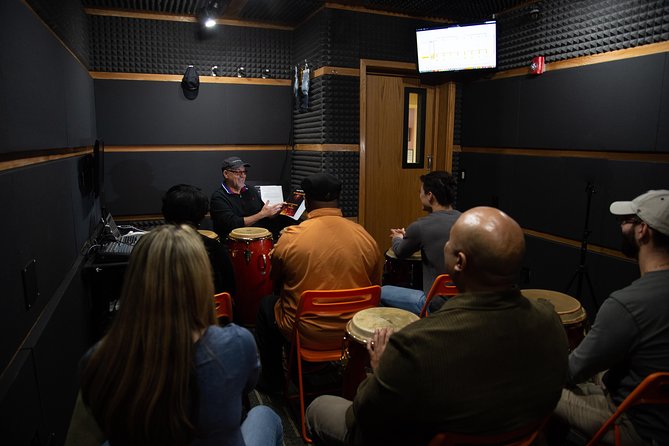
You’re capped at 12 people. That’s a sweet spot for this kind of class. You’re close enough to see hand position cues, and the instructor can correct you without turning the whole evening into one long wait.
In the reviews, the instructor—Manny—comes across as especially patient and encouraging with beginners. People specifically mention that he breaks things down in a simple way and helps them stay comfortable even if they’re worried they have no rhythm. That matters because conga playing isn’t just muscle memory; it’s also coordination. In a big class, beginners often feel exposed. In a small group, you’re more likely to get back on track quickly.
There’s also an extra human touch in the feedback: one group notes Manny helped tune a personal conga. Even if you don’t bring your own drum, that detail tells you Manny pays attention to the instrument side, not just the beat.
Taking home sheet music: how to keep your momentum
You get a printed copy of the music you learned, free of charge. That’s a big deal because most “try-it” music experiences leave you with a fun memory but no way to keep improving.
With the sheet music, you can practice after you get home and reinforce the pattern. You also get the chance to connect what you felt during the jam with what the notes look like on paper. The show’s emphasis on learning to read the notes helps here: you’re not just relying on listening. You’re building a skill you can repeat.
Practical takeaway: don’t treat it like a one-night performance. Use the sheet music to replay the rhythm until your hands stop hesitating. If you do, the next time you hear a Tumbao or Marcha-style pattern, your brain will recognize it faster—and that’s when drumming stops feeling random.





Price and value for $35 in Fort Lauderdale
At $35 per person, you’re paying for more than a short lesson. You’re getting about two hours of structured instruction plus a long audience jam, along with bottled water. And you also take home printed sheet music, which is something you’d typically have to recreate yourself if you learned from videos.
There’s also a BYOB element: alcoholic beverages are BYOB in moderation for people 21 and over. That isn’t required, but it’s good to know for the vibe. This is still a music lesson and participation show, so the goal stays on learning the rhythm, not party chaos.
Who is this good value for? If you want a fun evening that also gives you a real skill and a written resource to practice, this price structure makes sense. If you’re looking for private, slow, step-by-step coaching with guaranteed quiet time, you may want a different format.
Location and timing: Coral Springs, 8:00 pm start
The class meets at 7501 Wiles Rd, Coral Springs, FL 33067, starting at 8:00 pm. It ends back at the meeting point.
Because private transportation isn’t included, plan to drive, ride-share, or use your own local transit options. The start time matters too. An evening session is perfect if you want an activity that feels like a night out, but it’s not ideal if you prefer earlier-day experiences.
Also note: the activity is in English, and service animals are allowed. Confirmation comes at booking time, and there’s a mobile ticket involved.
Who this fits best (and who should think twice)
This experience is designed for beginners, and it works across ages. Children 8 years and more can participate, and the format is described as suitable for “almost anyone of any age.” That makes it a strong choice for multigenerational groups who want one shared activity that doesn’t require musical training.
It’s also a good fit if you:
- want a class that turns into a jam
- like hands-on learning
- want to leave with sheet music
- enjoy history with a practical payoff
You might think twice if you:
- strongly prefer quiet, seated instruction only
- get uncomfortable with active participation and loud drumming
- need a calm, distraction-free setting
The sweet spot is someone who wants to try drumming, learn a popular rhythm pattern, and actually play along by the end of the night.
Practical tips to help you get the most out of it
- Bring a mindset of participation. This isn’t a watch-and-learn lecture. You’ll get more from it if you’re ready to play from early on.
- If you have questions about technique, ask them while Manny is teaching the pattern. Small-group instruction is best used in the moment.
- Take the printed sheet music seriously. Even 10–20 minutes of practice after will help the rhythm stick.
- If you’re 21+, remember it’s BYOB in moderation. Keep the focus on drumming and coordination.
Should you book this conga class?
I’d book it if you want a fun night that also builds a real skill fast. The combination of a quick core lesson, a long 60 to 70 minute play-along, and take-home sheet music is exactly the kind of “learn it and use it tonight” experience that’s hard to beat for the price.
Skip it if you want a quiet, purely instructional workshop with no participation energy. And since transportation isn’t provided, make sure you’re confident getting to and from 7501 Wiles Rd on an 8:00 pm schedule.
FAQ
Where is the conga class meeting?
The class meets at 7501 Wiles Rd, Coral Springs, FL 33067, USA.
What time does it start?
It starts at 8:00 pm.
How long does the experience last?
The duration is approximately 2 hours.
How much is the ticket?
It costs $35.00 per person.
Can kids participate?
Yes. Children 8 years and more can participate.
Do I need any musical experience?
No experience is needed. Most people can participate.
What do I get to take home?
You take home a printed copy of the music you learned so you can practice after.
What is the cancellation window for a full refund?
You can cancel up to 24 hours in advance for a full refund. If you cancel less than 24 hours before the start time, it won’t be refunded.
More Tour Reviews in Fort Lauderdale
- Jungle Queen Riverboat 90-Minute Narrated Sightseeing Cruise in Fort Lauderdale
★ 4.5 · 1,753 reviews